
Logo of AutoCoder.cc

AutoCoder.cc

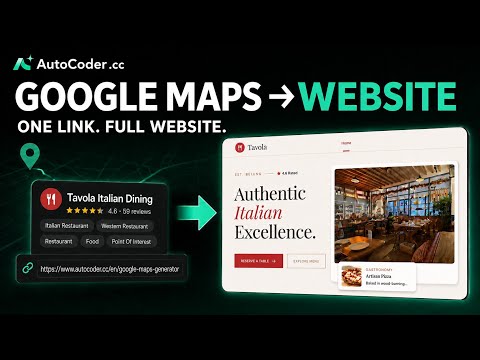
Turn a Google Maps Link into a ready-to-use website.

AutoCoder.cc is an AI-powered platform that turns any Google Maps location into professional promotional visuals for businesses, destinations, and local attractions. Users simply provide a Google Maps link, and AutoCoder.cc analyzes the available location information to help generate attractive, ready-to-share promotional images. No graphic-design experience, complicated editing software, or lengthy creative briefing is required.

The feature works with more than standard business addresses. Users can create promotional content for restaurants, cafés, hotels, retail stores, offices, residential properties, parks, landmarks, tourist attractions, museums, event venues, and other mapped locations. By starting with an existing Google Maps address, AutoCoder.cc makes it easier to transform a real-world place into compelling marketing content.

For example, a restaurant owner can paste the restaurant’s Google Maps link and use AutoCoder.cc to create promotional graphics highlighting its location, cuisine, atmosphere, opening information, and local identity. These visuals can support social-media campaigns, special offers, seasonal promotions, local advertising, and new-store announcements.

A hotel or vacation-property operator can generate destination-focused images that showcase the property’s location and nearby points of interest. A real-estate professional can turn a residential address into visual marketing material that emphasizes the neighborhood, accessibility, and surrounding amenities. Tourism organizations can promote parks, historic landmarks, scenic viewpoints, cultural sites, and visitor attractions with location-based creative content designed to capture attention.

The process is simple: copy a Google Maps location URL, submit it to AutoCoder.cc, select or describe the desired promotional direction, and let the platform generate the visual. Users can then refine the messaging, style, colors, format, and featured information to match their brand or campaign goals.

This location-to-visual workflow helps local businesses and organizations create marketing materials faster while reducing the cost and complexity of traditional design production. The generated images can be used across social-media posts, digital advertisements, websites, event promotions, travel guides, business listings, and other online channels.

Whether promoting a storefront, residence, landmark, park, venue, or destination, AutoCoder.cc turns a simple Google Maps address into polished promotional content—helping every location tell its story, strengthen its online presence, and attract more customers or visitors.

Latest updates from AutoCoder.cc

  1. AIGCodeAIGCode Latest

    Why do so many AI app builders still stop at the frontend?
    I’ve been testing a lot of AI builders lately, and one pattern keeps coming up:

    They’re incredibly good at generating polished interfaces.

    But the moment you need things like:

    • authentication

    • database logic

    • user accounts

    • payments

    • API integrations

    • persistent data

    the experience often becomes much more complicated.

    That’s interesting to me because a “working product” isn’t just a nice UI.

    A landing page can look finished in 10 minutes, but a real SaaS needs the backend to actually support users, data, permissions, and transactions.

    This is one of the areas we’ve focused on with Autocoder — not just generating the frontend, but helping users build the backend and product logic too.

    I think the next generation of AI builders will be judged less by:

    “How good does the first screen look?”

    and more by:

    “How much of the actual product can I ship without leaving the platform?”

    Curious how other builders see this:

    When you use an AI app builder, where do you usually hit the wall — frontend, backend, deployment, or integrations?

    3 0
  2. AIGCodeAIGCode

    Would you trust a production app that was 80% vibe coded?
    I keep seeing people ship surprisingly complete products with AI now — not just landing pages or weekend prototypes, but apps with auth, payments, databases, APIs, and real users. And it made me wonder where everyone draws the line.

    For an MVP, vibe coding feels like an obvious win. You move fast, test the idea, and avoid spending weeks building something nobody wants. But once real users, payments, and sensitive data enter the picture, does your mindset change?

    Do you start reviewing every line of AI-generated code? Do you bring in an experienced engineer? Or do you trust the agent and keep iterating the same way? I feel like the next big question in vibe coding isn't “Can AI build production software?”

    It's “Who is responsible for understanding the software after AI builds it?"

    Curious where everyone stands: Would you personally trust an app that was 80–90% AI-generated in production? What would you need to see before you felt comfortable shipping it?

    2 0
  3. AIGCodeAIGCode

    Building became the easiest part. That surprised me.

    When we started building Autocoder, I thought the hardest part would be writing software. Turns out, AI solved a big part of that. Today, I can go from an idea to a working prototype in hours instead of weeks. That's incredible. But something unexpected happened. The faster we built, the more often we built the wrong thing. We spent time polishing features that nobody asked for. We improved workflows that users didn't actually care about. We optimized before we validated. Eventually, we changed the way we worked.

    Instead of asking:

    "Can we build this?"

    we started asking:

    "What are we trying to learn?"

    That small mindset shift changed everything. Now every prototype is just an experiment. If nobody uses it, we delete it. If users love it, then we invest in making it better. Ironically, AI didn't make building the competitive advantage. It made learning faster. That's one of the reasons we built Autocoder—to remove the friction between an idea and something real that people can actually react to. Once building becomes cheap, your biggest advantage isn't coding anymore—it's knowing what deserves to be built.

    I'm curious: Has AI changed the way you build products, or only the speed at which you build them?

    3 0

About AutoCoder.cc

AutoCoder.cc is a development product listed on Uneed, with a free tier and paid plans. It's tagged with AI, Development. See the best AI products for related options.

Frequently asked questions about AutoCoder.cc

What is AutoCoder.cc?

AutoCoder.cc is turn a Google Maps Link into a ready-to-use website.

Is AutoCoder.cc free?

AutoCoder.cc offers a free tier with paid plans available for additional features.

What are alternatives to AutoCoder.cc?

Discover similar ai, development, no-code products in the Uneed directory.

What category does AutoCoder.cc belong to?

AutoCoder.cc is listed under Development on Uneed.

What users say about AutoCoder.cc

Maki3991

I’ve used Autocoder to create product demos and test web projects, and I’m impressed by how quickly it turns a basic idea into a working website. The prompt-based workflow makes it easy to build and refine pages without spending too much time on setup. It supports both front-end and back-end functionality, which makes it useful for prototypes, demos, and early-stage projects. A practical tool for moving from an idea to a working product.

alisaaaaaxxx-deac

use autocoder to make a local small business web in 10 min, i know nothing about coding, but it is easy to build. the web is sooo cool and attracts more customers. it made my business look more professional!

Read all 6 reviews